Publications
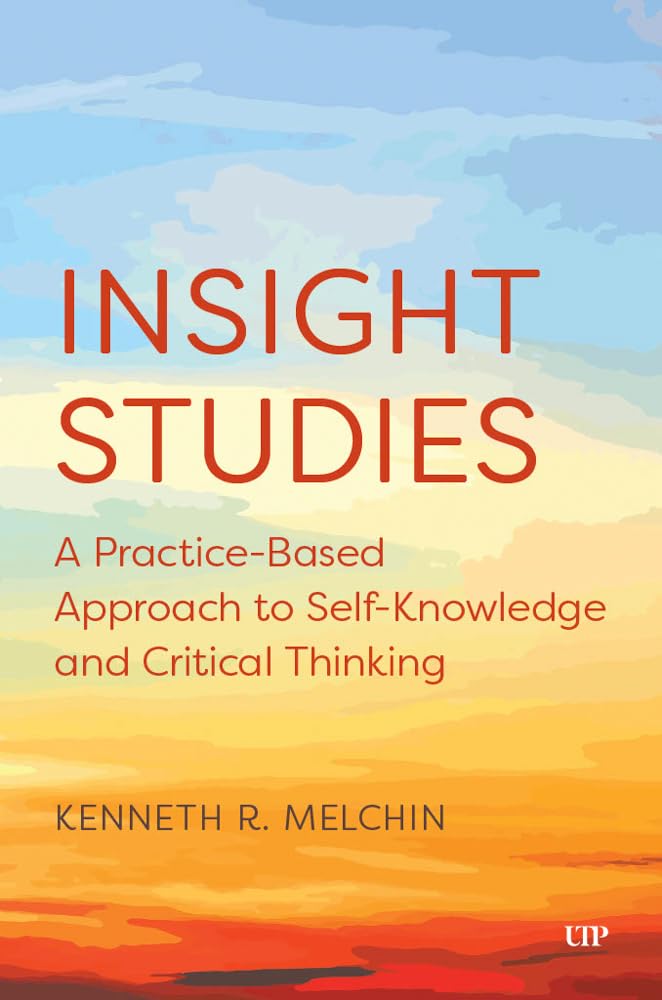
Insight Studies: A Practice-Based Approach to Self-Knowledge and Critical Thinking
Melchin, Kenneth R. Insight Studies: A Practice-Based Approach to Self-Knowledge and Critical Thinking. University of Toronto Press, 2025.
Insight Studies emphasizes the importance of understanding the operations that generate and verify the knowledge we rely on in our daily lives. Grounded in the philosophy of Bernard Lonergan, the book employs a practice-based approach similar to learning a musical instrument, fostering critical thinking skills through engaging learning modules.
The book features modules that include puzzles with detailed instructions to help learners focus on their own cognitive processes and operations of knowing. This approach broadens the scope of critical thinking to encompass the operations of questioning, understanding, verifying, valuing, and cooperating. Each chapter illustrates the relevance of these skills across various fields, including ethics, conflict resolution, psychology, sociology, philosophy, politics, and personal relationships.
Structured as a nine-module course text, Insight Studies can be adapted for in-class, online, or self-directed learning. Designed to be learner friendly, this book equips readers with transformative skills that are applicable to everyday life.
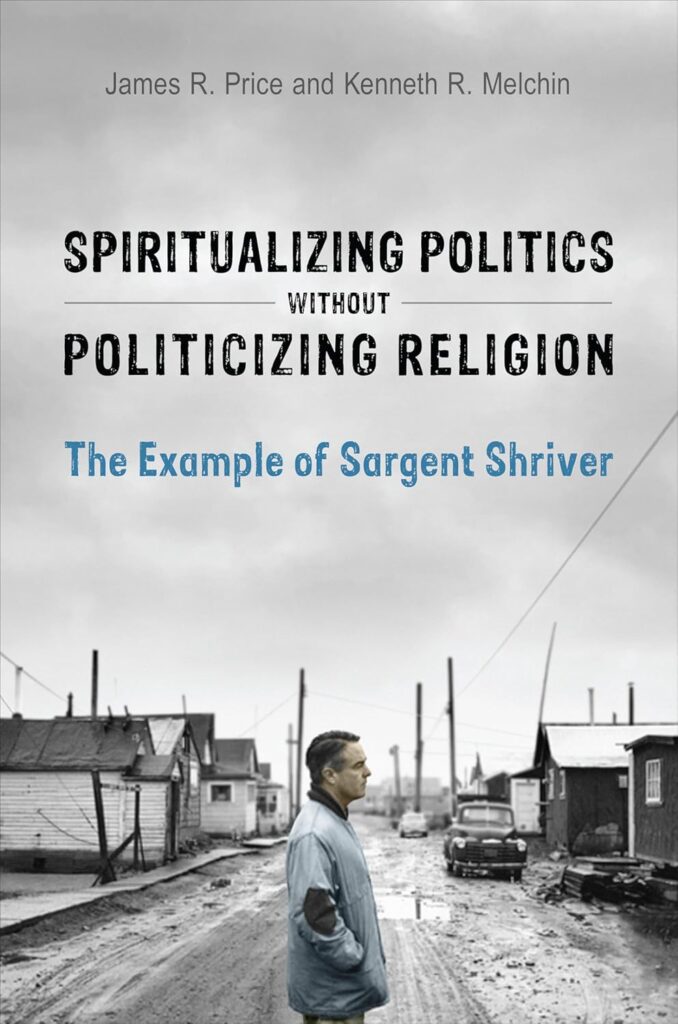
Spiritualizing Politics without Politicizing Religion: The Example of Sargent Shriver
Melchin, Kenneth R. Insight Studies: A Practice-Based Approach to Self-Knowledge and Critical Thinking. University of Toronto Press, 2025.
The clash of religion and politics has been a persistent source of polarization in North America. In order to think wisely and constructively about the spiritual dimension of our political life, there is need for an approach that can both maintain the diversity of belief and foster values founded on the principles of religion.
In Spiritualizing Politics without Politicizing Religion, James R. Price and Kenneth R. Melchin provide a possible framework, approaching issues in politics via a profile of Sargent Shriver (1915–2011), an American diplomat, politician, and a driving force behind the creation of the Peace Corps. Focusing on the speeches Shriver delivered in the course of his work to advance civil rights and build world peace, Price and Melchin highlight the spiritual component of his efforts to improve institutional structures and solve social problems. They contextualize Shriver’s approach by contrasting it with contemporary, landmark decisions of the U.S. Supreme Court on the role of religion in politics. In doing so, Spiritualizing Politics without Politicizing Religion explains that navigating the relationship of religion and politics requires attending to both the religious diversity that politics must guard and the religious involvements that politics needs to do its work.
The Call: The Spiritual Realism of Sargent Shriver
Price, J. The Call: The Spiritual Realism of Sargent Shriver. Sargent Shriver Peace Institute, 2023.
The Call looks at the role of the spirit in the life and work of one of the most accomplished American peacebuilders of the 20th twentieth century, Robert Sargent Shriver (1915-2011), founder of the Peace Corps and architect of the War on Poverty. Author Jamie Price knew Shriver personally and served as the Founding Director of several programs dedicated to understanding and advancing Shriver’s approach to leadership and peacebuilding.
The Call is an imagined dialogue between Sargent Shriver and the character of Didymus about the role of the spirit in Shriver’s efforts to build peace. Its title alludes to the pivotal moment when Shriver received the phone call from his brother-in-law, the newly-inaugurated President John F. Kennedy, asking him to be Director of the as-yet-nonexistent Peace Corps. This “true conversation that never happened”, informed by Shriver’s hundreds of speeches, philosophers and theologians who inspired him, and conversations between Shriver and the author, is an intimate, unique, often funny exchange about the inner workings of a mind always questioning the relationship between spirit and social action. A must-read for aspiring leaders, innovators, and peacebuilders seeking to redress contemporary challenges to human dignity and security, The Call invites readers to navigate conflict and nurture human connection with creativity and compassion.
Transforming Conflict through Insight
Melchin, Kenneth R., and Cheryl Ann Picard. Transforming conflict through insight. University of Toronto Press, 2008.
Examining the difficulties of conflict resolution, Transforming Conflict through Insight demonstrates how applying Bernard Lonergan’s philosophy of insight to mediation can lead to more productive and constructive negotiations. Kenneth R. Melchin and Cheryl A. Picard provide both an overview of conflict research and an introduction to Lonergan’s “insight theory,” offering an outstanding piece of ethical philosophy and a useful method of mediation.
Introducing readers to a method of self-discovery, the different kinds of operations involved in learning, and the role of feelings and values in shaping interactions with others in conflict, this volume also includes the practical experience of mediators who detail strategies of insight mediation for working creatively through conflict. Attending to the important role played by transformative learning in navigating conflicts, the authors show how insights and learning can move people past obstacles caused by feelings of threat.
Informative, compassionate, and convincing, Transforming Conflict through Insight is a welcome resource for working to resolve difficulties in an ethical and educational manner.
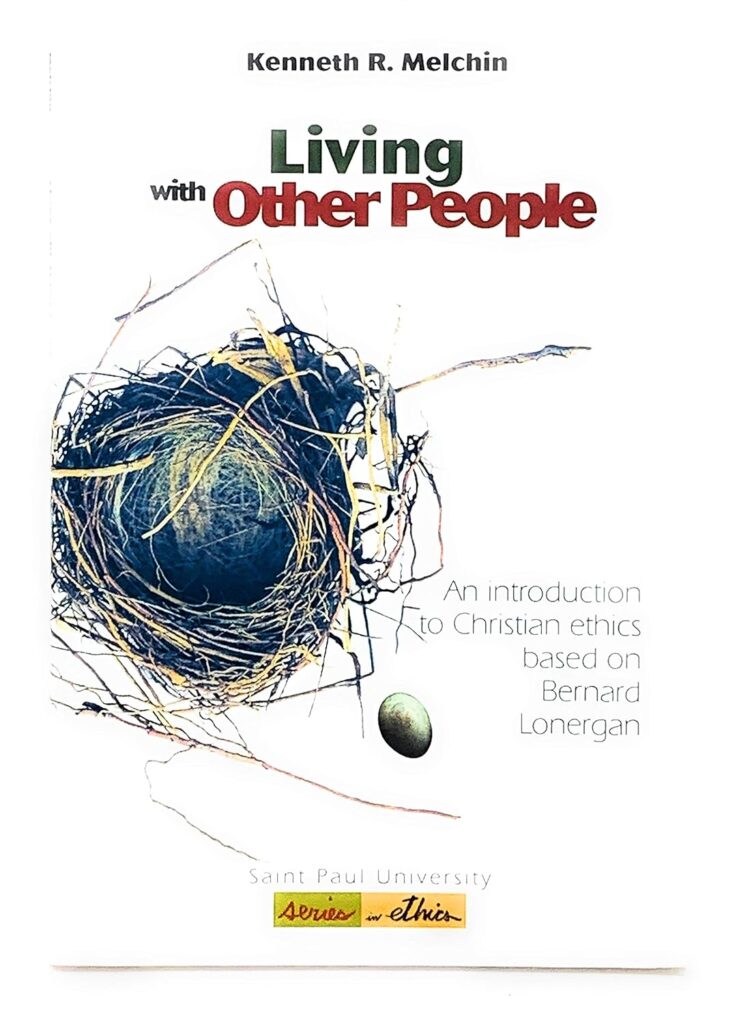
Living With Other People: An Introduction to Christian Ethics Based on Bernard Lonergan
Melchin, K.R. Living with Other People: An Introduction to Christian Ethics Based on Bernard Lonergan. Novalis, 1998.
In “Living with Other People” Kenneth Melchin goes beyond merely translating Lonergan. He provides readers with basic tools for moral self-understanding and deliberation by offering an entrance into moral living that is innovative and refreshing, given years of moral casuistry, moral manuals, rules, and precepts. Melchin not only understands Lonergan accurately, but has inventively applied his work in a variety of ways. Thus, his role with regard to Lonergan studies goes well beyond “exegeting” Lonergan to “applying” Lonergan. Due to his astute grasp and creative use of Lonergan, this account of moral life is put into language that is “accessible” and uses examples to draw readers in. Melchin begins with the ordinary person’s experience and builds on that piece by piece, adding to the basic notion of moral “skills” the elements of social context, the problem of evil, the Christian response to it, and, therefore, the role of faith in moral decision making. Eventually he discusses “principles”: justice, the common good, the preferential option for the poor, the dignity of persons. But this comes only after the dynamic structure of living–knowing, deciding, and acting–has been carefully outlined.
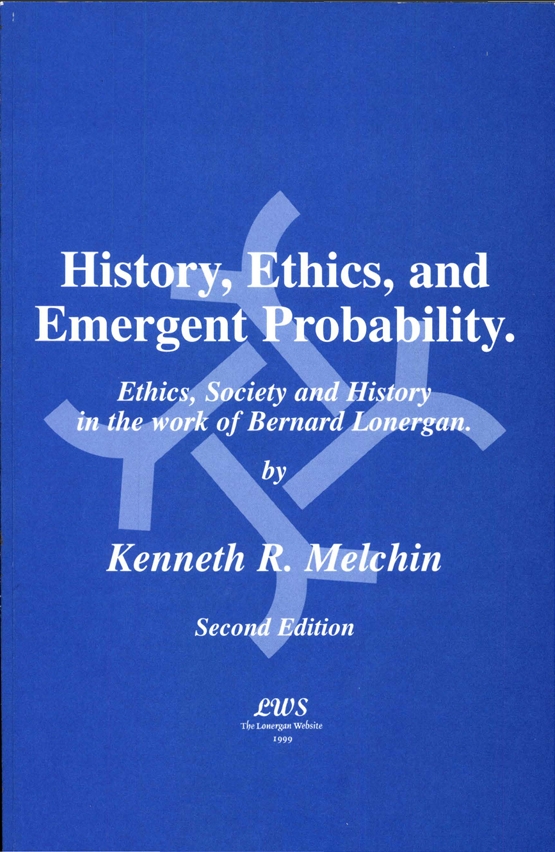
History, Ethics, and Emergent Probability: Ethics, Society, and History in the Work of Bernard Lonergan
Melchin, Kenneth R.. History, Ethics, and Emergent Probability: Ethics, Society, and History in the Work of Bernard Lonergan. United Kingdom: University Press of America, 1987.
Reruns regularly show their age to their clear disadvantage. Science fiction of a decade ago can be comic rather than thrilling. Here we have a rerun of a decade ago that is mightily successful. It is not science fiction, but science fact. What is that fact? It is the fact that Kenneth Melchin puts up front in the title. It is the fact of Emergent Probability as an explanatory world view, an achievement of four hundred years of science that came into focal blossoming in the mind of Bernard Lonergan during the early forties.
What Melchin does here is something very rare. He does not let you off the hook, comfortably swimming the ocean of post-scientific meaning. He wishes you to tackle the tough climb towards an explanatory appreciation of the fundamental form of our universe. Is he successful in his challenge? I recall Oscar Wilde’s post-perfonnance comment: the play is magnificent, the audience a failure.
— Quote from Forward to the Second Edition
Selected Articles
Elisabeth Nicholson, “Ecumenical Dialogue and the Insight Approach to Conflict Mediation” – Journal of Ecumenical Studies
56, no. 2 (2021).
Thomas McAuley, “A Note on Popularized Mindfulness, Mindfulness in Thich Nhat Hanh, and Mindful Appropriation of the
Cognitive-Existential Operations of Consciousness According to Bernard Lonergan” – Theoforum 50 (2020): 269-282.
Susan Gray, “Deconstructing Bias and Reconstructing Solutions” – Feminist Theology 25 (2017), and other work on Lonergan,
feminist theology, grace, gender oppression, and violent extremism.
Selected Book Chapters
Thomas McAuley, “Water Ethics under Development: Help from Lonergan’s Method” – in Everything Is Interconnected: Towards
a Globalization with a Human Face and an Integral Ecology.